Blog · August 31, 2026
Can a padel court be engineered as Risk Category I?
Short answer: sometimes, and when it works it is worth real money. But it is the building official's call, not the manufacturer's, and it has to be argued correctly.
What risk category actually is
ASCE 7 assigns every structure a risk category based on the hazard to human life if it fails (Table 1.5-1). Category II is the default for ordinary buildings. Category I is reserved for structures that represent a low hazard to human life in the event of failure, the classic examples being agricultural buildings and minor storage facilities. Category III and IV cover assembly buildings and essential facilities.
The category picks which wind speed map you design to. That is the whole game. At a Palm Beach site, for example, the Risk Category II map gives roughly 170 mph and the Category I map roughly 160 mph. Because wind pressure scales with the square of velocity, that ten miles per hour is about a 12 percent reduction in every pressure, every post reaction, every anchor force, and every footing moment in the calculation. On a structure that is nothing but wind load, that shows up directly in steel, embedment, and concrete.
The case for Category I
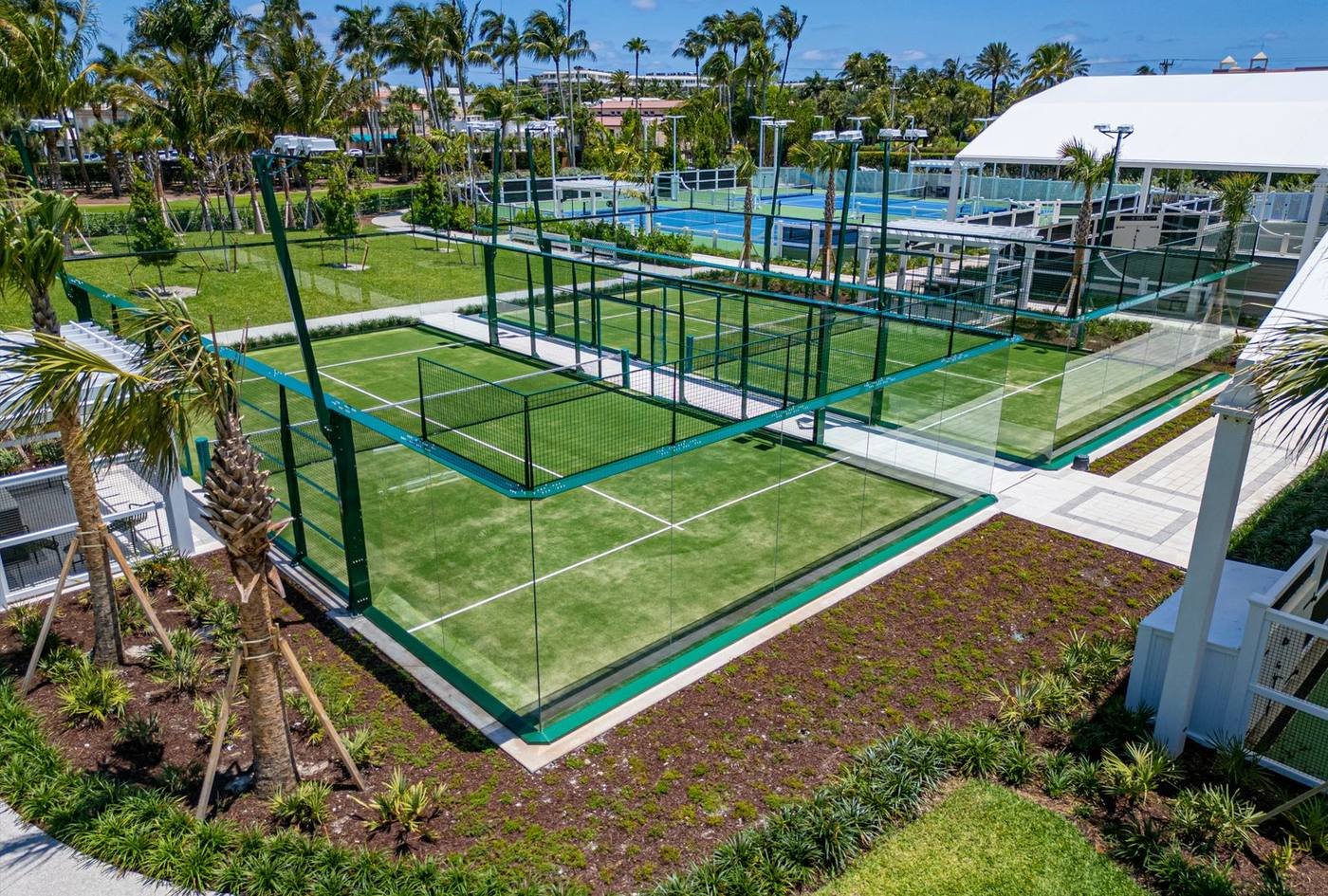
A padel court is a freestanding, open-air recreational structure. Nobody sleeps in it, nobody shelters in it, and when a hurricane is approaching, nobody is playing padel. The realistic occupancy during a design-level wind event is zero, because the same storm that produces the design wind clears the property days in advance. Failure threatens property, not life, which is exactly the distinction Table 1.5-1 is drawing. On that reasoning, a court is closer to a detached accessory structure than to an occupied building, and Category I is defensible.
The case against, and where it fails
The counterargument is about what the court can hit, and who reviews the argument. A court standing between a clubhouse and a pool deck, or beside a hotel tower, sheds glass and steel into occupied territory when it fails. Some plan reviewers also read "low hazard to human life" narrowly and will not extend it to a structure people stand inside for hours a day, storm or no storm. And in the High-Velocity Hurricane Zone, expect less flexibility generally; Miami-Dade and Broward reviewers are conservative for good reasons.
So the honest engineering position is: Category I is a site-specific argument, not a default. It works best for courts on open ground with clear separation from occupied buildings, in jurisdictions that engage with the ASCE 7 rationale. It should not be forced where the surroundings or the reviewer do not support it.
How we handle it
We have engineered and permitted padel courts under Risk Category I where the site supported it and the jurisdiction accepted the classification, and we design to Category II where it does not. The classification, the map speed, and the reasoning go on the cover of the sealed calculation package, so the reviewer sees the basis rather than discovering it. When an owner wants the lower category purely to save money on a tight site, we say no, because a rejected classification costs more in resubmittals than it ever saves in steel.
Two practical notes. First, the difference matters less than people hope in the HVHZ, where even Category I speeds remain extreme and other provisions govern much of the design. Second, if your court was originally permitted as a temporary structure, risk category was probably never evaluated at all, and that conversation is part of converting to a permanent permit.
Written by the engineering team at Oasis Engineering LLC. This article is general information, not engineering advice for a specific site. For your court and your jurisdiction, talk to an engineer.
Ready to get your court permitted?
Send us the court drawings. We'll tell you what the permit needs within one business day.